Empress (Godspeaker, Book One) by Karen Miller fantasy 717 pages
Have you ever read a book only to find that you don't like the majority of the characters, you find the writing to be mediocre at best, you think the world-building only succeeds some of the time and yet...you find yourself wanting to read the next page (and the next book in the series) because you really have to know what happens next? Or maybe it's just me?
Empress is the story of Hekat, a girl born into horrible, back-breaking poverty in a part of the world that sees women as useful only for bearing sons. At 12, as soon as she has her first period, her father sells her to slavers. One of the slavers thinks she's something special and treats her better than the rest of his stock and certainly better than she was treated at home.
She learns a great deal from the slavers as they traveling from The Savage North (no really, that's what it's called, right there on the map) to their home city of Et-Raklion, way down in the south. We learn along with her and here's where the shaky world-building comes in. We do learn that it's only in the north that women are totally disenfranchised and that, further south, they can serve as warriors and priests (godspeakers) of the nameless, monolithic God, and yet we see them still being treated poorly elsewhere. While yes, that happens even in our own society, the way it's handled here feels like Miller didn't really think everything through.
We also learn that this is an almost insanely religious society; the godspeakers are everywhere, sacrificing live animals at the drop of a hat, doing magic, enforcing curfews, advising the warlords who are the head of the secular side of the government and generally interfering with people's lives. Although the whole setting has Middle Eastern overtones, the one good thing I can say is that this doesn't really read like a fantasy version of Islam.
Once Hekat and the slavers reach Et-Raklion and she learns that, while she's "beautiful and precious" (a phrase she and other people use about her all the goddamn time), she's still a slave and not as important to the slavers as she thought. She runs away and that's essentially where her story really begins.
There's nothing really new about her journey (it's a pretty typical "rise to the top while not caring about who you step on to get there" trope) and the fact is, she's a rather unpleasant character--manipulative, lacking in any real empathy, and incredibly selfish. It makes sense given her background, but it also makes it kind of hard to care about what happens to her. The people around her, with the exception of Vortka, a young man taken from the same slave train as Hekat and made a godspeaker, are mostly annoying as well. The high godspeaker of Et-Raklion, Nagarak, is scheming and ambitions; the warlord, Raklion, is a good soldier, but easily manipulated, and so on.
On top of it all, if it weren't for the adult nature of the sex scenes and the sacrificial scenes (seriously, avoid this book like the plague if you hate animal death or ifscorpions freak you out), I'd think it was a YA novel. Miller's writing is incredibly simplistic and repetitive; off the top of my head, I could easily name twenty fan fiction writers in my current fandom who are much much better writers.
And yet, as I said up there at the beginning of the review, I blew through this book and will undoubtedly be grabbing the next one. I don't know what it is, but sometimes a story will manage to break through all of the obstacles the author throws in its way and demand that you finish it. So I ask again: that ever happen to any of you?
Anathem by Neal Stephenson science fiction 935 pages
I've been putting off this review for a while because I feel a little like Wayne and Garth--not worthy. However I need to move on and so here I am, taking my best stab at it. I'm going to try to avoid too many spoilers, but some are inevitable, as are excessive italics, due to many made-up words.
On a world known as Arbe, the study of science, mathematics and philosophy is limited to the avout, cloistered scholars who live in maths or concents (a concent is a large community often made up of more than one math) and who only interact with the Sæculum (secular world) on a limited basis during the Apert, a yearly period of ten days when the gates of the concent open and people from both the secular and mathic worlds can mingle. The concents are divided into groups: the Unarians (one-offs, whose members remain cloistered in the math for a year), the Decenarian (tenners, whose members are cloistered for ten years), Centenarians (hundreders, whose members are cloistered for one hundred years) and the Millenarians (thousanders, whose members are cloistered for one thousand years). Within the cloistered world are many different Orders who study different things and have many different philosophies, but all of them abide by the long-established rituals and rules of the Cartasian Discipline.
Sounds like the set up for a fantasy novel set in some medieval not-quite-Earth, right? Not so much, actually. The world outside the concents is modern and technological, with cars and cell-phone analogs (called jeejahs, which is a great word) and TV and so on, and the work done inside the concents is scientific and not religious. This is an old world with over 7,000 years of recorded history; there have been set backs and failures of the system more than once, including three great Sacks (when the outside world attacked the concents), and something called The Terrible Events, which sounds a lot like a nuclear war or some similar technological planetary disaster.
The story begins with our hero, Fraa Erasmus (known to his friends as Raz), facing his first Apert. He's a tenner who's been at the Concent of SauntEdhar since he was a small child and is now at a point where he needs to decide what he's going to do with his life. During the Apert, he meets his sister and we get a look at the difference between the thinky, mostly low-tech world of the concents, where everything is discussed to death and beyond, and the secular world, full of commerce, industry, somewhat mindless entertainment and flash in the pan religions.
After the Apert, Raz and his circle of friends realize that something is going on within the concent; the starhenge (observatory) has been closed off and the older fraas and suurs (the concents are co-ed) seem to be a little worried. Things come to a head when Raz's mentor, FraaOrolo, an astronomer who's made a dangerous discovery, is tossed out of the concent in a rite known as anathem (a lovely portmanteau word made up of "anthem" and "anathema"). As Raz and his friends figure out why, they are called to leave the concent and travel to a world-wide convocation, where they will help advise the secular authorities on the crisis. Normally, the secular authorities would provide transportation for the avout, but with so many being called, the scholars are forced to make their way on their own.
And so, Raz, his sister Cord, Sammann (an ita--one of the concent's technology experts), a thousander named FraaJad and several others set out on a journey across Arbe. Their quest includes adventures along the way, as well as several detours while Raz attempts to find his mentor, but finally, they reach the convocation, only to get caught up in plans to defend the whole planet from the threat from space discovered by FraaOrolo.
If Anathem were nothing more than the story of Raz's journey and subsequent mission to save his planet, it would be a fantastic addition to the quest genre of SF. The world-building is excellent and nuanced, the characters are engaging, the story is fascinating and the climax is exciting and enjoyably convoluted. Even the background romance between Raz and one of the suurs from his order is handled well.
But this is Neal Stephenson and so the book is much much more than that; there are layers upon layers here. One of the layers is historical--for someone up on their history, it's easy to see that Arbe is what our world would be like if the ancient Greek philosophers and scientists had retreated behind walls and all their knowledge had not been lost, but rather added to throughout the subsequent centuries. It's a lot of fun to read about historical events on Arbe and say "oh hey, I know where he got that from!"
Then there's the philosophy of language and science layer, which is the stuff that probably loses Stephenson readers. The characters talk everything to freakin' death; there's a section that's almost 100 pages long in which, during a series of dinners, senior fraas, suurs and a secular politician discuss the crisis from any number of philosophical angles. I kind of got lost in there because philosophy is not exactly my forté, although I really do like the position of the Lorite school of thought, which is that everything that can be thought of has been thought of already; the Lorites pretty much exist to say "so-and-so had that idea back in 2015" every time someone comes up with something, which might be annoying for the characters but amused me.
If you're a long time Stephenson reader, you're probably either really really intelligent and educated and can follow his digressions, or you're the kind of person who takes what he's talking about on faith and reads his books for the sheer enjoyment factor and the possibility that you might learn something new. Either way, you're used to books with huge amounts of information about various subjects woven into the narrative-- language theory in Snow Crash, for example, or cryptography in Cyrptonomicron. In other writers this kind of thing is annoying and info-dumpy, but somehow, Stephenson makes it work.
One of the things you look for in computer/video games is the level of replayability--do you want to play GTA: San Andreas again when you finish, or are you just done with it? For me, that's a concern with books as well--can I reread them and get something new out of the book? Anathem is going to be one of those books I will return to again and again, and each time, I'll pick up something I missed the time before.
While Stephenson uses a number of made up words for this (including bullshytt, which only kind of means what you think it does), there are definitions scattered throughout the book and an glossary at the end of it. There's also a historical timeline as well as several appendices that help illustrate some of the concepts Stephenson uses in the novel.
So yes, at 900+ pages, this is a massive undertaking, but seriously, if you have the time, read it. It's easily Stephenson's best novel since Snow Crash and as his first attempt at setting a story in a world other than Earth, it is truly brilliant and detailed world-building. The characters are engaging, and, for all the discussion that goes on, the action sequences are gripping.
Of the twenty-two books I've read so far, this is the one I want everyone to take the time to read. Trust me, it's worth it.
Side note: someone actually made an amateur trailer for the book. It's a bit cheesy in places, but it's an interesting piece of transformative fan work.
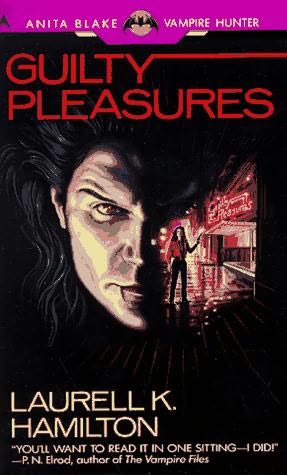
Guilty Pleasures 265 pages The Laughing Corpse 293 pages Circus of the Damned 329 pages The Lunatic Cafe 369 pages supernatural detective fiction by Laurell K Hamilton
You know how I said I was going to review Anatham next? Yeah, I lied. For one thing, I'm totally intimidated; I doubt I can do it justice. For another thing, well I'm kind of depressed and so I holed up in bed yesterday and today and read four rather dreadful books, one right after the other. Somewhere in there I slept a fair amount as well.
Mind you, I didn't go out and buy these; it seems a certain person I'm married to went on a kick several years ago and so we have a whole stack of them on the shelf. I grabbed the first one because...well, because I didn't want to have to think or read anything complicated.
Anyway, I'm not going to go into a huge amount of detail on these; they don't really deserve it and I just want to get them on the list and move on, hopefully to a much better, brighter day.
Guilty Pleasures is utter "how the hell did this woman ever get published" crap. In it Hamilton introduces Anita Blake, animator--means she can raise the dead--and vampire hunter and sets up her world, in which supernatural creatures are real and the public knows about them. To be honest, she does a crappy job of world-building; I just can't buy some of the changes she makes in the legal system, but whatever. In this one, Anita is hired by the chief vampire of the city--St. Louis, which apparently is vampire central--to find someone who's illegally killing vampires. In the middle of all this, Jean-Claude, owner of a vampire strip club called Guilty Pleasures , ends up putting two of the four "marks" that can turn a person into a "human servant" on Anita. Jean-Claude is an arrogant asshole who calls Anita "ma petite" and the fact that I think we're supposed to find him sexy is just another strike against the book. The mystery isn't all that complicated and the writing is stilted; Hamilton is better than Stephanie Meyers, but that's about all I can say for her.
The Laughing Corpse pits Anita against a Mexican voodoo queen while investigating a number of truly grisly murders. Oh yeah, there's also some rich guy who wants Anita to raise a zombie, only the zombie's been dead long enough that a human sacrifice will be required and Anita won't do it. On top of it all, there's the annoying Jean-Claude, now Master of the City, who's being threatened because he can't even keep his human servant in line. He keeps after Anita, trying to convince her to let him put the rest of his marks on her so, presumably, she can spend the rest of an unnaturally long life dealing with a condescending jerk. Anita's not exactly my favorite fictional character ever, but honestly, I can't blame her for trying to avoid this clown. Of the four books I read, this is actually the best one--the plot moves along nicely, the writing's smoothed out some and the mystery is actually fairly complicated. I'd say that if you had to read one of these books, this would be the one to read.
Circus of the Damned has Anita dealing with what looks like a rogue gang of vampires on a killin' spree. However, near as I can tell, the main purpose of this book is to introduce us to Richard, the junior high teacher who also happens to be a were-wolf. And here's where I say, with all due sincerity, Laurell, honey? Stick to the action/adventure genre and leave the romance writing to someone, anyone, else. Reading Anita and Richard flirting is enough to make you want to kill yourself. It's not the painful but realistic flirting of two people who aren't supposed to be good at it; on no, this is supposed to be cute and snappy. Also, there's more Jean-Claude, who manages to put his third mark on Anita, but then, after the final battle with more rogue vampires, removes all his marks. Whatever, he's still a tool. This one isn't nearly as good as Laughing Corpse; it's not a mystery so much as a little action/adventure and a lot of romantic set up.
The Lunatic Cafe is the werewolf novel. Well, there are other were-creatures as well, but in this one, there's a mysterious death by critter and also some icky were-creature snuff porn floating around. Mostly, though, it's about Anita trying to deal with her relationship with Richard, the sensitive New Age were-wolf. Also there's a ton of posturing; seriously, there's this one meeting with several were-creatures that's pages and pages of people talking about dominance and who's in charge. I kinda wanted to scream "I fucking get the point, okay?" but it wouldn't have done any good. Also, yes, there's more Jean-Claude, this time he demands equal dating rights or he's gonna take Richard out even if it means that Anita will come gunning for him. The mystery part of this one is only so-so, but I don't think you're really supposed to care because this is all about setting up the big love triangle.
Part of my problem with these books is that I rarely like anyone in them. There are a few side characters--a couple of cops and Anita's private detectiveBFF--who aren't bad, but that's just not enough. Some authors can make unlikeable characters work, but you have to be much better at the craft than Hamilton is. In the end, I just don't care about Anita, or which of her two annoying suitors she picks or what her next supernatural case may be.
I have no idea what I'm reading next, but I know it'll be better than these four books.
Also, OMG is that like the cheesiest cover in the history of...well, forever?
Knowing that I lived in Iran for a couple of years in the '70s, a friend of mine just recently gave me the very nice, all-in-one-volume version of Persepolis by MarjaneSatrapi, which I've been wanting to read for a while. And then today....
Well, today we got a new car. My mother-in-law, for reasons surpassing understanding, bought a brand new Jetta last year, in spite of the fact that she was hardly driving at all and had a perfectly good, late model Volvo. Now that she's living with a cousin and has sold her condo, she doesn't need the car and so she had it shipped from Chicago to us here in California. It's completely paid for, has only 900 miles on it and it even still smells like a new car.
Now ever since she decided to sell her condo, she's been asking Nancy if there was anything she wanted, since Nancy had left some stuff in the basement way back when she went to college. And Nancy kept saying, "no Mom, I really don't need any of that stuff, except that it might be cool to have all my old Nancy Drew books." So, there in the surprisingly roomy trunk of the car were two boxes of Nancy Drew books. I flipped through some of them, thinking I might read a few, only...they're all under 200 pages.
The point--other than OMGYay New Car!!!--of this long-winded digression is that I seem to have changed my reading habits to the point where I won't let myself read anything that doesn't qualify for Cannonball. It's kind of stupid really; I'm doing pretty well--last I checked, I'm in third place--and Godtopus knows that I've got more free time than a lot of other people doing the Read. I could probably take some time to read something--other than fan fiction--that doesn't qualify, but I just feel like it would be wrong or something.
My brain, she is weird sometimes.
Come next September or 100 books, which ever comes first, I'm probably going to have a huge stack of graphic novels--I mean really, I've never read Watchman or Y, the Last Man and recently I've been wanting to reread the collected Sandman--and short books waiting for me.
Valor's Choice 282 pages The Better Part of Valor 315 pages science fiction by Tanya Huff
Okay now that I'm (mostly) recovered from Election Week and am writing again, it's time to get back to the books. Or book. Or books.... A Confederation of Valor is two books in one, which made my wallet kind of happy because I'm old enough to remember when paperbacks weren't eight or nine bucks a piece. *rattles walker and shouts at clouds*
Tanya Huff is one of those versatile authors who really should be more popular than she is. She writes pure fantasy (the Quarters series), modern/urban fantasy (the Keeper series), the vampire/magical detective genre (the Blood Ties series and the Smoke series) and military SF (the Valor series) and all of it's good. She's also a filker* and a lesbian who frequently puts gay characters in her books--Tony, the protagonist of the Smoke series is gay and, unfortunately, in spite of the fact that the books are really good and properly creepy, there probably won't be any more in the series because her publisher pulled the plug on it. Apparently gay doesn't sell enough books. Her Blood Ties series was made into a really cheesy, but fun TV series; it was filmed in Canada on the cheap and then played on Lifetime for two short seasons.
I happen to have a soft spot for military SF and, honestly, I don't really know why. Most of the people writing it are pretty right wing/Libertarian and their politics often show up in their work. Still, gimme a band of Marines battling the odds on an alien world, or a steely-eyed starship captain going up against the enemies of her empire and I'm a happy camper. So finding out about this series was great because I know that Tanya's politics are much closer to mine and I already like her writing.
The Valor series is about Staff Sergeant Torin Kerr of the Confederation Marines. The fact that she's female isn't such a big deal; David Weber's Honor Harrington series is about a female starship captain, for example. Still it's not all that usual in the space marine genre, which made it a nice change.
The other really nice change is that unlike most of the books you run across in this genre, which are about Humans only or Humans fighting aliens, Huff's Confederation is made up of many different species. The older and wiser species have sociologically evolved beyond aggression, which created a problem when they encountered the Others, who were not interested in peaceful negotiations. And so the Confederation recruited younger, more aggressive species, including Humans, who had barely made it into space when the Confederation came calling.
In addition to Humans, the Marine corp includes the di'Tayken--an elf like species who give off so many sexual pheromones that they have to wear mechanical maskers--and the Krai--a species that can and will eat literally anything, including the bodies of both their enemies and their own honored dead. So in addition to the usual personality tensions in any military unit and military politics in general, there's also some species tensions.
Valor's Choice is the first book of the series. Kerr and a platoon of Marines are sent on what is supposed to be easy duty: guarding diplomats and helping show the flag on a mission to the planet of the Silsviss, a reptilian race that is looking to join the Confederation. As the senior NCO, Kerr is also responsible for breaking in a new Second Lieutenant, something made complicated by the fact that he's a di'Tayken she had a one night stand with, not knowing he was an officer.
Of course things go awry; after an initial round of "getting to know you" encounters, the suborbital ship containing the diplomats and the Marines is shot down over a wilderness preserve used to test Silsviss males during their aggressive adolescence. It's up to Kerr to see that everyone survives and the ensuing struggle is exciting, to say the least.
Kerr's a good character--smart and dedicated but not without a dry sense of humor--and it's easy to like her and to give a damn about what happens to her. Huff also does a good job making what could be boring stock characters come to life; the baby officer from a military family who's afraid he's not up to the task; the trouble-maker with a heart of gold; the card-shark; the alien who knows more old Earth expressions than the Humans, and so on. There's even a nod to a common trope of these stories; one of the guys is reading letters from home and counting the days until he sees his family, and his friends all remind him that in movies, he's the guy who always buys it. The diplomats from the older species of the Confederation are interesting as well; not only is she good at inventing aliens with cool cultures, Huff does a good job envisioning how true pacifists would react to a sudden plunge into a combat situation.
The Better Part of Valor takes place shortly after Valor's Choice. Having insulted a general, Kerr gets pulled from her platoon and is given the dubious honor of leading a recon squad and a bunch of scientists into a mysterious derelict ship floating in space. In addition to a thrown-together squad, a politically appointed officer who's more concerned about his PR status than anything else, Kerr has to deal with a news crew and the wise-cracking salvage operator who discovered the ship.
One of the things Huff's good at is setting up a good creepy situation and then running with it. (The mummy in Blood Lines, for example, is really fucking freaky and I don't normally find mummy stories to be all that scary.) A big abandoned space ship with an interior that changes into rooms pulled from the minds of the explorers offers plenty of opportunity for creepiness, particularly when a group of the mysterious Others--the Confederation's bug-like enemies--show up to explore the ship as well.
Both these books move along a nice clip; they're fun and exciting and, unlike so many books in the genre, there aren't any right-wing politics buried under the surface. There are two more books in the series and I'm looking forward to getting my hands on them. If you like the genre, run, don't walk, and if you're not sure about the genre but like a good, well-written SF adventure, give them try.
Next up...Neal Stephenson's latest masterpiece. That's not a word I use lightly; Anatham is utterly fantastic.
*For people who don't speak Geek, filk is folk music for SF/Fantasy geeks. The songs are usually SF/Fantasy based, but there's filk about computers as well. Sometimes both the music and the lyrics are original, but a lot of the time people rewrite popular songs with their own lyrics. It's a true nerd pastime that mostly goes on a SF cons. Thus endth the lesson.
After reading Tigana, or any book by Kay, you aren't surprised to discover that he's an accomplished poet as well. In fact, when Christopher Tolkien took on the job of publishing The Silmarillion from his father's notes, Kay was one of the people who worked with him. Trust me, Kay's better when he's writing his own stories.
Fortunately for me, Tigana was the first book by Kay that I read. His earlier trilogy, The Fionavar Tapestry, suffers from such a bad case of "everything and the kitchen sink" fantasy that you end ip thinking that Kay never met a fantasy trope he didn't like. Thankfully, he got that out of his system and sat down to create Tigana.
Roughly half a generation before the events of the book, the lands of the Palm--a peninsula divided into nine tiny duchies and principalities with vaguely Italian names and language--was conquered by two different sorcerers. One, Alberico, is a pretty straightforward villain, but the other, Brandin is a much more complex character. Unfortunately for the Principlaity of Tigana, Brandin's beloved son died at the hand of Tigana's prince. In revenge, Brandin performed a mighty act of sorcery that prevents anyone not from Tigana from hearing or remembering the name of the principality. As a result, when the last person alive at the time Tigana was conquered dies, the name of the country will be lost forever.
And so the stage is set for a band of rebels, including Alessen, the youngest son of Tigana's last prince, to try to win back their freedom and the freedom of the rest of the Palm's provinces, because along the way, Alessan has realized that the only way the divided provinces can prevail is through unification.
All that sounds pretty normal; talk about your common fantasy tropes. But where Kay excels is in...well, honestly, pretty much everything. His heroes and heroines are flawed, complicated people and Brandin is an excellent example of how to do a villain right. In fact, while I do love the rebels, particularly Devin, a young singer who falls almost accidentally into the conspiracy, it is the story of Dianora, a native of Tigana who is taken captive and put into Brandin's harem only to struggle against her love for him versus her desire for revenge that makes me love this book.
Well, that and the sheer beauty of Kay's prose. He's a simply stunning writer who uses language and imagery perfectly, and who knows the power that words have. If you like truly sparse prose, then no, his books aren't for you. However, you never feel that he's throwing words at the page in order to bring up his page count; each word seems placed just so, much like the mosaics created by another one of his characters from another book. The result is a picture of love and loss and honor and responsibility that will stay with you for a long time.
If someone came up to me and said, "I don't normally read fantasy, but can you recommend a good starting place?" I'd hand them Tigana and tell them to sit down and savor it from cover to cover. While there is magic in the book, it never takes over the book the way it so often can in fantasy.
Across the Nightingale Floor by Lian Hearn fantasy 287 pages
Taking place in the Three Countries, a place much like feudal Japan, Across the Nightingale Floor is the first book of the Tales of the Otori. It tells the story of OtoriTakeo and ShirakawaKaede, two young adults caught up in the intrigues of their time.
Takeo is a young man raised in an isolated village by his mother, a member of a forbidden religious sect. The local lord, Iida--an ambitious villain with no real redeeming features--with his men, destroys the village. Takeo is saved by a mysterious stranger by the name of Lord Otori, who takes Takeo to his lands and adopts him.
Meanwhile, the beautiful Kaede is a hostage, held by one of Iida's vassals to compel her father's loyalty. When a man attempting to rape her is killed and the man she is betrothed to dies, she becomes the object of superstition, although that doesn't stop her captor from setting up yet another betrothal--to Lord Otori--for her
Takeo learns that he is the son of a member of The Tribe, an ancient group of ninjas. He has an almost magic ability of super hearing, which serves him well when Lord Otori summons an old Tribe friend to train Takeo. Their ultimate goal is to assassinateIida, who is so paranoid that he has a "nightingale floor"--a floor designed to make chirping noises when someone steps on it--surrounding his chambers.
The book rushes on with an almost breakneck speed and yet there are moments where Hearn pauses to describe a landscape or a room with an appreciation that adds a Japanese touch to the novel. It's not written in the style classical Japanese literature, which, as someone who gave up on The Tale of Genji, I appreciate, however, you never forget that you are in a world of samurai and ninjas.
There was a moment when I was sure she was leading up to a pretty common trope, but then, when I was wrong, I realized that I was thinking of Western tropes and Hearn was using a common Eastern trope. While she doesn't actually bring anything new to the table, she tells her tale well and gives us likable characters and deeds of ninja derring-do in enjoyable settings.
I call Across the Nightingale Floor fantasy because that's what it's categorized as, but, aside from Takeo's super-hearing and his family ability to hypnotise people, there's no magic; this could be read as a straight-forward action novel with a nice touch of romance in the background. I most certainly recommend it; I sat and read it in one go tonight and I'll be getting my hands on the other books in the series; there are three more that deal with Takeo and Kaede and then a prequel about Lord Otori.
The Maltese Falcon by Dashiell Hammett mystery 229 pages
First off, yeah the book's out of order; I have Lies My Teacher Told Me partly written up but it's proving to be a difficult write-up and this one shouldn't be.
I haven't wanted to do too many re-reads for this, but in this case, I haven't read it in something like 15 years so I figured it couldn't hurt, particularly since I knew the ending back when I read it the first time.
It's an easy read, even if you have somehow managed to avoid seeing the movie. A mysterious woman shows up in a detective's office with a story that's mostly bullshit. Detective's partner goes off on the job and gets killed. Detective slowly works his way to solving partner's death and the woman's case. There's sex, booze, guns and a lot of fast talk. Dude, it's Sam Spade, which really...'nuff said.
While there are bits and pieces in the book that didn't make their way into the movie--Gutman's daughter, for example--almost all of the dialog in the movie was lifted right from the pages of the book. If you're at all an aural reader like me, it adds a nice layer to the book. The first time Joel Cairo shows up--and while the movie coded him gay, the book flat out states it--all I could hear was Peter Lorre's voice as I read.
One of the most interesting things about the book, and something I'd have not noticed until I started writing, is that the point-of-view is so distant and omniscient that you're never allowed into anyone's head. I'm sitting here thinking about writing like that and it's just weird to me, although really, it's kind of the ultimate in "show, don't tell."
Anyway, it's a fun and fast read, so if you haven't ever read it, you might want to check it out.
Lies My Teacher Told by James W. Lowen non-fiction 318 pages
By the time I was in high school, I could list the post-Norman Conquest rulers of England in order and probably tell you at least a little bit about each one of them. I knew that 1492 wasn't just important because that's when Columbus sailed, who Xenophon was, how Chaucer was related by marriage to the royal family, why Persepolis had been in ruins since Alexander's day and that Cleopatra was neither the first of her name nor actually Egyptian*.
American history bored the crap out of me.
Reading Lies My Teacher Told Me makes me wonder if my boredom had more to do with presentation than anything else.
Lowen looks at how high school history books present, or more accurately don't present, controversial subjects. You know, things like how Columbus was an asshole who was in it for the money (also people knew the world was round back then), how most of the Indians in the Northeast were killed off by a plague they picked up from European fishermen before the Pilgrims got there, how John Brown wasn't so crazy actually, how Reconstruction really didn't play out the way you think it did and, hey, what about class differences in the US?
What we get in our textbooks, or at least the 12 Lowen read through, is feel-good history. It's designed to make white kids feel good about being Americans. There is no controversy and things just happen without the cause being examined. And that, right there, boggles my mind. If we don't know why things happened, how can we recognize when they're happening again; how can we watch our own times and not think about cause and effect?
I wonder how different my level of interest would have been if I'd been given more than feel-good history. As it was, I got an A and then forgot all the boring dates I'd had to learn and happily went back to reading European and Ancient history. In my spare time. For fun.
Go figure.
Any way, it's a good book and a fantastic antidote to crappy high school history.
*1492 was the year of the Reconquista, when the last of the Moors were kicked out of Spain; whether this was a good thing or not depends on your point of view. Xenophon was a Greek historian who, in 400BCE, helped lead a group of mercenaries from Persia back to Greece. He wrote about it in a book called Anabasis, or The Persian Expedition. Geoffry Chaucer, author of The Canterbury Tales, was married to Phillipa Roet, whose sister Katherine was the mistress and later third wife of John of Gaunt, son of Edward III and uncle to Richard II. Persepolis was burned by Alexander's troops and by all accounts, Alexander wasn't at all happy about it. The Cleopatra we've all heard of was actually Cleopatra VII, the name was, like the name Berenice, a very common name back in the day. She wasn't Egyptian; the royal family had been Greek since Egpyt was conquered by Alexander.
Keeping it Real by Joanna Robson SF/Fantasy 333 pages
Okay, to be honest, I was a little iffy about this one. It's a cross between urban fantasy and cyberpunk with a cyborg heroine whose job is to protect a hot elf rock star. Within the first five pages Lila, our heroine, actually looks at herself in the mirror in order for the author to have a chance to describe her--pretty much classic Mary Sue stuff, particularly as, in spite of all the metal attached to her body, she still comes across as pretty hot.
There were other tells that made me wonder if Robson started out as a fan fiction writer*; most glaringly, the little bit of Common Knowledge at the beginning of the book reads like the kind of thing you wouldn't have to explain if you were writing about a universe everyone already knew. It's almost like she didn't know how to present the information any other way, except for that part where she does a halfway decent job of exposition early on.
But you know? I'm kind of glad that I was reading it for Cannonball, because I stuck with it and it was actually a lot of fun.
The basic premise is that there was some sort of awful explosion, called the Quantum Bomb, involving a super collider. The resulting rip in the space time continuum leads to six different worlds existing in parallel to one another: there's our own world (called Otopia for some unknown reason); Zoomenon, the world of the Elementals, Alfheim, where the high/Tolkien style elves live; Demonia, where the Demons hang out; Thanotopia, the land of the dead from which necromancers gain their power; and Faery, and yeah that's pretty obvious.
The Elves are all about Culture and so the fact that Zal the High Elf is a rock star in Otopia is cause for death threats against him. So, enter Lila Black, half-machine, half-human agent. She's brought in as his bodyguard, but also ends up playing a "Game" with him. Games are complex interactions that end with the loser paying a forfeit; in this case, it's pretty easy to guess what the game is, and in fact, the book itself follows the whole "hot bodyguard/sexy rock star" formula, only the peril is a lot more interesting than usual.
I'd recommend this one if you're halfway decent at suspending your disbelief and are looking for a fun, only slightly trashy, romp. It sounds like I'm damning it with faint praise, but the fact is, I enjoyed it for what it was and have every intention of picking of the next in the series.
*Not that there's anything wrong with that; I can easily name a handful of SF/Fantasy writers who started out writing fan fiction. In fact....
Okay, this is where I suddenly lose a lot of cred and probably some respect from some of you people, but...I'm a fan fiction writer and have been for the last 14 years. I've also published one short story that's been reprinted a couple of times, most recently in Best Lesbian Bondage Erotica. But mostly? I write (mostly) gay porn about TV shows and movies and even actors.
Confessions of an Ugly Stepsister by Gregory Maguire fantasy 368 pages
Having enjoyed Maguire's look at Oz and since my spouse-person happened to have this book on hand as well, I figured I might as well see if it was any good. The Cinderella myth is not one of my favorites, but then I'm not that fond of fairy tales in general. This version, however, really did pull me in.
Maguire made the decision to set the story in Holland in the 1630s, setting the familiar characters firmly in the emerging middle class. The narrator, Iris--the younger of the two step-sisters--her older but simple sister Ruth and her mother Margarathe arrive in Haarlem from England after Margarathe's husband died. Margarathe finds employment as a housekeeper, first with a painter and secondly with a wealthy merchant who's made a lot money speculating on tulips.
When the merchant's wife dies, Margaratheslides into her place and the familiar story begins to take shape. But of course, this isn't the story of Cinderella (who starts off as Clara); it's the story of Iris, a plain girl who happens to have some artistic talent. It's fascinating to watch Iris struggle to deal with her mother's ambition, her own infatuation with the painter's apprentice, her desire to paint, and, of course, Clara's beauty.
There is no actual magic in the book, although there are a few things that strain the reader's willing suspension of disbelief. I really liked the psychological explanation for Clara allowing herself to be banished to the kitchen, and loved the little details about painting and the lifestyles of the Dutch Bourgeoisie. My main issue with the book is a silly personal one; the other step-sister, the one who is slow and big and clumsy? Couldn't Maguire picked a name other than Ruth?
Oh hey, I'm one tenth of the way there! I'd buy more books to celebrate, but it's the end of the month. Huh...I wonder if my fees are paid off at the library.
Wicked: The Life and Times of the Wicked Witch of the West by Gregory Maguire fantasy 406 pages
Okay, so I lied about what my next book would be; in case it isn't clear, my book selections for this are pretty random and are aimed at me having not having to spend too much of my fixed income on books. I happened to be cruising our bookshelves and found this and, since it was recently reviewed, both on Pajiba and by one of my fellow cannonballers, I figured why not?
It's been a while since I read an Oz book, but back in the day, I read all 14 of L. Frank. Baum's Oz books and possibly some of Ruth Plumly Thompson's books as well. And here's where I pause and suggest that you get your hands on some of the follow-ups to Wizard of Oz and just look at them. John R Neill took over the illustration job with the second book and his work is just gorgeous.
So yeah, as a former Oz fan, I was looking forward to revisiting the world as an adult though an adult book but also kind of dreading it because, well, what if it sucked? Fortunately, it didn't suck; in fact, it's pretty damn good.
Basically the book follows Elphaba, later known as the Wicked Witch of the West, from her birth to her death at Dorothy's hands. It concentrates on five different periods of her life: her childhood in Munchkinland; her years at university where she meets, among others, Glinda the Good; her time in the Emerald City as a rebel against the Wizard; her time in the Winkie country, where she prefected her witchiness; and finally, the short aftermath of the death-by-house of her sister.
Maguire's Oz is Baum's Oz "through a glass darkly;" it's recognizable but full of things like specism (the talking Animals are treated as second class citizens), religious schism, class warfare and so on. It's an echo of the ills the Industrial Revolution brought along with it and caught up in all this is Elphaba, whose earnest desire to do good gets twisted until she's the Wicked Witch we all recognize.
It's not a perfect novel, but it's a fun one, even if the only background you have is the original Wizard of Oz movie.
Next up--probably--Confessions of an Ugly Stepsister, Maguire's take on Cinderella.
The Book of Saladin by Tariq Ali historical fiction 367 pages
As you might have guessed, I'm into medieval history. You can't be all that into medieval history and not know at least a little about the Crusades. In fact, I've read a fair number of non-fictional accounts of the various Crusades, but.... But, of course, they've all been about the European experience in the Holy Land, even when the author is not painting the Western knights as heroes.
One of the few Muslim leaders you hear about if you know even a little about the Crusades (even if your only exposure was, say, the historically inaccurate mess that was Ridley Scott's Kingdom of Heaven*) is Sultan YūsufṢalāḥ ad-Dīn ibnAyyūb, better known to Westerners as Saladin. Sadly, aside from reading his wikipedia article, I know very little about Saladin from sources other than Western authors. In legend, he is, along with Richard I (of England, aka the Lion-Hearted) one of the great chivalrous leaders of the Crusades and the only "Saracen" respected by the other side. Since most of those legends aren't at all accurate about Richard, I tend to take them with a grain of salt.
The Book of Saladin is written from the point of view of Isaac ibnYakub, a Jewish scribe selected by Saladin to write his biography. Along the way, ibnYakub also talks to a couple of the women of Saladin's harem and Saladin's oldest friend. He also travels with the Sultan from Cairo to Damascus and finally, to Jerusalem, which Saladin takes back from the Christians. The result is a fascinating look at life on the other side of the Crusades.
Ali sticks to history when it comes to things like Saladin's accomplishments; the man's life really was remarkable and there isn't any need to embroider it. However, he invents the the various women in the book because medieval Islamic historical accounts don't even give us the names of the mothers of Saladin's sixteen sons. And while he does a good job at showing us how extraordinary Saladin was, you never really feel that you're getting into his head. He remains a distant figure for most of the book, while the invented women of his harem feel very real and interesting. In a way, however, the fact that Saladin is distant actually works; he is, after all, the Sultan, the figure around whom everyone else in the book revolves.
It's a good book and is a lot more readable than many historical novels; Ali is an excellent storyteller. Apparently this is the second of Ali's Islamic Quintet--although it certainly stands alone--and I intend to get my hands on the rest of them.
Next up, something that isn't historical fiction, probably either Keeping it Real by Justina Robson or Lies of Locke Lamorra by Scott Lynch.
*Don't get me wrong, I love Kingdom of Heaven, as incredibly flawed as it is. Where else could you hear Liam Neeson say: "I once fought for two days with an arrow in my testicle."
The Reckoning Sharon Kay Penman historical fiction 587 pages
And so I come to the end of Penman's Wales books. To be honest, The Reckoning is a bit of a disappointment. It picks up shortly after Falls the Shadow and deals with the conflict between Llewelyn and Edward I (also known as Edward Longshanks) over the ultimate fate of Wales. There's yet another woman involved, Simon deMontfort's daughter Ellen, promised to Llewelyn before her father died.
One of the problems with historical fiction, even if it's not technically a romance, is that the writers want us to believe that each match involving their main characters is a love match. In the first book, Here Be Dragons, there is some real evidence that Llewelyn the Great loved his wife Joanna; in a time when no one would have blamed him for divorcing her after finding her in bed with another man, instead, he welcomed her back into his life. But really, did Simon love his Nell? Did the second Llewelyn love his Ellen? Penman wants us to think so and I'll go with it, but after a while, you have to wonder.
That's not the only problem with the book, in fact, it's not even my major issue with it. My real problem is that it's anti-climactic. Not because I knew Edward was going to win, but more because I don't really find the second Llewelyn as interesting or as passionate as I found Llewelyn the Great or Simon de Montfort in the first two books. Nor is Ellen nearly as interesting as her mother Nell, or her great-aunt Joanna. There are moments when Penman tries to make Edward a sympathetic character, but she never really succeeds. Even the constant flip flopping of Llewelyn's brother Davydd--who went back and forth between siding with Edward and siding with his brother--and the part where pirates capture Ellen--something that really did happen--aren't enough to make the book work for me.
In the end, of course, rocks fall and the Welsh die. Ellen dies in childbirth, Llewelyn dies in battle and Davydd is possibly the first person to have been hung, drawn and quartered. Wales falls to Edward, who went so far as to give Llewelyn's title of Prince of Wales to his son, as all (or at least most) succeeding monarchs have done. In my write up of Falls the Shadow, I said that knowing the end doesn't really matter, and yes, that's true. But you have to have interesting people to get me to want to read the book, to engage me even though I know it'll all end badly. These weren't those people.
See, the problem with historical novels, particularly the ones about visionaries and rebels, is that even if you know little about the period or person, you can pretty much count on them ending badly. The author can also be a clue about the relative happiness of the ending and when you read Sharon Kay Penman, whose first novel was a sympathetic account of the life of Richard III, you can bet that she picked a heroic but ultimately tragic figure for follow.
Falls the Shadow is a tragedy, even the name gives it away. It follows the life of Simon de Montfort and Llewelyn of Wales. This isn't Llewelyn Fwar (the Great) who was one of the main characters of Here Be Dragons, rather, it's his grandson, who is trying to hold together his grandfather's dream of a free or at least a united Wales against the treachery of his brothers.
But for all this trilogy is ostensibly about Wales, the main character of this book is Simon de Montfort. He's one of those men who crops up in history from time to time, someone who is just plain ahead of his time in many ways. Penman shows us a man who truly believed that his God-given duty as a knight was to look after people more helpless than himself. In the course of his life, he managed to force the King of England--Henry III, son of King John and not much better a ruler than his father--to not only honor the Magna Carta but also the Provisions of Oxford, a much more democratic outline for governing.
Deposing a king was srs bizns back in those days and Simon claimed he did everything in the King's name, that his quarrel wasn't with Henry, who was his brother-in-law--Simon married Eleanor, Henry's sister--but with Henry's useless advisors. During Simon's period of control, the first elected parliament met in England. Granted, the only people who could vote were those men who held property worth 40 shillings or more, but still, we're talking about the middle of the 13th century here.
And in the end, of course, that was the problem. Instead of giving more power to the barons and other nobles, Simon's Provisions favored the very small, nascent middle-class--the Provisions of Oxford was the first legal document published in English since the Conquest. It was just too early for this kind of thing, plus, in the end, Simon faced a much more serious opponent than the dithering Henry: Henry's warrior son, Edward, later known as Edward I or Edward Longshanks.
And Wales? It gets very short shrift in this book, but at the end of the book, Llewelyn is still free and trying to hang onto his country. Even without reading it, I know that the next book in the series--The Reckoning--will see the end of his fight and not in a good way. After all, these days the Prince of Wales is an Englishman, not a Welshman.
So why read something when you're pretty sure going in that it'll all end in tears? To know how it happened, and to see one version of what the people involved might have been thinking. After all, look at how many versions of the Arthurian legends have been written and how popular Colleen McCullough's Masters of Rome series is. Without Simon de Montfort and the Provisions of Oxford, which didn't last long after his death, the history of English democracy and eventually US democracy might have been very different. Which would be why, even though very few people have heard of him, there's a plaster relief of his head in the chamber of the United States House of Representatives. I get the feeling that de Montfort, or at least Penman's version of him, would be honored.
Consider Phlebas Iain M. Banks science fiction 467 pages
Well that was bit of a romp with an annoying ending. The first of Banks' novels set in the world of "The Culture", Consider Phlebas follows a fairly standard plot line. A "Mind," an AI capable of running a space ship, escapes an attack on its ship and lands on Schar's World, a Planet of the Dead. It's a valuable thing/person and both sides of the Idiran-Culture War want to get their hands on it. The Idirans, religious fanatics trying to convert the galaxy, send in Horza, an agent of theirs and The Culture, a post-scarcity society run by AIs so the humans can live the good live, send in Balveda, one of their own agents.
Horza is a Changer; he can take the on the form of other people and along the way, he picks up some fairly lame space pirates and their ship, with Balveda in tow. After that, it's pretty much a Quest for Treasure story, featuring some interesting stops and settings as it moves on.
I can't explain my disappointment with the end without spoiling the book, but in spite of that, I haven't ruled out reading more of Banks' Culture books. This one is an enjoyable space opera with a few gross-out scenes, the usual space and ground battles and some very mildly written sex.
I should probably talk about my spoiler policy. For anything somewhat recent, I'll try to avoid spoiling the book if I can. I'm a little more inclined to spoil for the historical novels; when I get around to Colleen McCullough's Antony and Cleopatra I may mention the fact that Antony loses. Not only is this a matter of history, it's also been covered in any number of books, plays and movies and if you didn't know, well too bad.
The Memoirs of a Survivor Doris Lessing fiction 219 pages
So I stayed up all night last night. I do this sometimes, usually when my sleep schedule is fucked or I want to run errands before Darkrose heads out to work at 11:30. So, as you do after you've been up all night, I stopped at my favorite coffee place--Butch n Nellies--and got myself a 20 oz Mexican Mocha. While waiting for my coffee, I checked out the book exchange bookshelf and, in amongst all the romances, was The Memoirs of a Survivor. Bear in mind, as you read this review, that I still haven't slept and all I've had is the mocha and some sun chip things from Trader Joe's.
Now it's easily been over 25 years since I read any Lessing and when I did, way back in high school, it was her rather odd science fiction series Canopus in Argos: Archives. And honestly? I don't remember a blessed thing about them other than that they were complicated.
The Memoirs of a Survivor is...complicated in some ways and incredibly simple in other ways. Set in a dystopian future, a woman becomes responsible for a twelve year old girl named Emily and her half-cat/half-dog pet, Hugo, as the city they live in falls apart around them. Told in first person from the POV of the woman, whose name we never learn, the novel records the slow slide as the city and society in general falls apart due to some undisclosed series of events, as well as the life that Emily makes for herself in the new shifting social order. Laid over this is the narrator's experience with and in the strange and shifting landscape of a series of rooms beyond a blank wall in her flat. At times the mysterious rooms show her a strange, antiquated version of Emily's childhood and at other times, they are more impersonal reflections of the chaos that goes on outside the flat.
I'm not sure if I can recommend this or not, because I still haven't decided if I like it or not. I like the deceptive simplicity of Lessing's writing and a good dystopia will grab my attention every time, but I'm still trying to figure out what happened in the end.
Welcome to: Boom Kitty, Jen Ji, Merc, Mrs. Walker and Rusty (all conveniently linked to in my handy list to the right)! Good luck to you all!
I'd introduce myself but I really don't know what to add to the information that's already over there in my About Me section. If anyone wants to know more, however, I'm always willing to talk about myself, so just ask.
Finally, I don't have a real plan for The Read except that I'd like to get through the huge stack of "books we own that I want to read." Well and there's also "use The Read as an excuse to buy books." So, I'm open to recs. I like:
* historical fiction (obviously) -- my preference is for the Medieval, Renaissance and Baroque periods in Europe and the various great civilizations of the Ancient Near East (Egypt, Persia, Greece, Rome) but I want to expand my horizons into something a little less Western Canon.
* historical non-fiction/biographies -- see above.
* science fiction and fantasy -- Anything good, although if it's by Neal Stephenson or Guy Gavriel Kay , I've either already read it, or will be reading it. I'm mostly over typical fantasy rewrites of Tolkien and if you rec anything by Heinlein I will indulge in a rant about how much he sucked. I like vampires but dislike zombies unless the book is really really good.
* Anything that's so transcendentally excellent that I should read it even if I'm not wild about the genre. Basically, I'm interested in the book you give to people and say "I know you're not wild about mysteries/modern fiction/romances/whatever, but you have to read this."
The one book I try to get everyone to read even if they don't like the genre? Snow Crash by Neal Stephenson. Seriously, freakin' read it, okay?
Here Be Dragons Sharon Kay Penman Historical Fiction 700 pages
After reading crappy historical fiction, I wanted to read the good stuff, so I went for the first of Sharon Kay Penman's Welsh Trilogy, because I love her book The Sunne In Splendour which is about Richard III and the War of the Roses. Here Be Dragons is about an even more obscure period of British history--the end of the 12th, beginning of the 13th centuries. Yup...it's the Robin Hood era and this book is partly about Evil Prince John.
Actually, it's is about two very different rulers, John in England and Llewelyn in Wales, and--yes, I know this sounds like a movie ad--the woman who was forced to choose between them. John inherited the extensive Angevin Empire--all of England and half of medieval France--created by his father Henry II. Llewelyn inherited one third of Wales in a time when the Welsh princes had to swear fealty to the English crown. Quite the power imbalance and yet, an ambitious Welsh Prince could still make quite a lot of trouble for the English. So John looked for a way to get Llewelyn on his side and found it in an arranged marriage between Llewelyn and Joanna, one of John's many illegitimate children.
This is pure history, all these people existed. However because all we know of Joanna is that she was John's bastard daughter, that she married Llewelyn, had children with him, that there was a scandal and when she died, Penman has a great chance to invent a fascinating character and she makes the most of it. John only learns about Joanna after Joanna's mother dies and he rescues the young girl from poverty and obscurity. At that point in his life, she's his only daughter and whatever else history has to say about Bad King John, it tells us he was a devoted father to both his legitimate and illegitimate children. Of course, Joanna learns to love her father; she knows little of his personal flaws or the mistakes he's making as king of a kingdom beset with money issues and French enemies.
When John marries Joanna off to Llewelyn, who is 32 years old to her 14, she's understandably terrified. She finds herself in a country where very few people speak her language and most of her husband's subjects, including his son from an earlier liaison, resent her presence, both because she's English (although she rightfully points out that that's an insult; she's Norman) and because she's her father's daughter.
Penman could have gone the easy route and had Joanna and Llewelyn fall for one another immediately, but, although eventually they learn to love each other passionately, it takes them a while to get there. And even afterwards, it's hardly an easy marriage, particularly as Llewelyn's ambitions for Wales puts him more and more at odds with John. John for his part, is struggling and making bad decision after bad decision; he is, after all, the king who was forced to sign the Magna Carta.
And yes, it sounds kind of dry, but in spite of her habit to indulge in the occasional info-dump, Penman brings these people to life enough, makes them real enough, that you really do want to know what happens to them. That you learn things--like the fact that the Magna Carta went too far and took too much power from the Church, and so John had the Pope's backing in his war on the barons--along the way is cool, but you never lose sight that in the middle of all this history is a woman who is torn between her father and her husband. Joanna's not a passive character; she's got the family temper and she's intelligent. Watching as she faces the facts about her father is painful but it feels very real to anyone who's ever loved someone only to realize that they're not a good person.
And really, that's where historical fiction can shine and a good writer can keep their readers hooked. By making history about real people with motives and concerns we can understand, the novelist can take us past the dry facts and show us that, in the end, history isn't about forces we can't understand, but about sons whose parents didn't love them, daughters who have to make hard decisions and mothers who want the best for their children.
Next up? To Serve and Submit which is some kind of fantasy novel that promises to be both soft-core porn and a fascinating story about one girl's epic journey. It better deliver.
What?! A girl's gotta take a break from the weighty stuff and have a little fluffy fun.
I'm a 40something, recently married, disabled lesbian living in domestic bliss with my partner Darkrose and our two cats.
I read, write, play computer games, cook, and occasionally make a vague stab at doing housework. I'm a Liberal with a capital L and I have opinions. About everything.




 Posts
Posts